Featured Enterprise & Retail Appliances
Explore our top-tier export appliances engineered for global distributors, retail brands, and B2B buyers seeking rigorous EU certification and high performance.
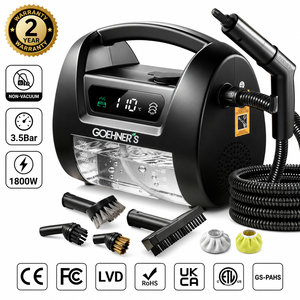
230F Constant Dry Steam 1800W Instant Portable Canister Pressurized Commercial Steam Cleaner
Get Catalog
Engineering Architecture of CE Certified Slow Juicers
A granular analysis of thermodynamic dissipation, masticating torque physics, food-contact metallurgy, and compliance frameworks for enterprise procurement directors.
Low-Speed Mastication Physics (40–60 RPM)
Traditional high-speed centrifugal juicers operate at 6,000 to 18,000 RPM, introducing extreme mechanical friction and heat generation (often exceeding 45°C). This thermal spike triggers rapid oxidation, destroying delicate heat-sensitive enzymes such as superoxide dismutase (SOD) and Vitamin C. Our CE certified slow juicers utilize high-torque, low-RPM spiroid augers operating at 43 RPM. By applying hydraulic pressing forces rather than high-speed shearing, the cellular walls of fruits and vegetables are gently collapsed, releasing bound micro-nutrients while eliminating aeration and foam formation.
Brushless DC Motor & Thermal Control
The core engine of a commercial slow juicer relies on continuous heavy-load torque density. Our manufacturing facility integrates industrial-grade Brushless DC (BLDC) motors equipped with planetary gearboxes. Unlike standard AC motors that suffer from thermal decay during extended 30-minute extraction cycles, BLDC assemblies maintain a constant 200W–250W torque output while operating under 55 dB noise levels. Microprocessor-controlled automatic reverse functions prevent clogging when processing dense fibrous roots like ginger, turmeric, and beetroot.
Food-Contact Metallurgy & Polymers
European retail compliance demands absolute chemical neutrality under acidic conditions (pH 2.5–4.0). All cold-press augers manufactured in our plant utilize heavy-duty Ultem (PEI) resin, offering 4x the tensile strength of standard ABS. Liquid extraction chambers are molded from Eastman Tritan™ Copolyester, guaranteed 100% BPA/BPS-free. Micro-mesh strainers are laser-welded using medical-grade Stainless Steel SUS304/SUS316, preventing heavy metal migration and ensuring compliance with EU Regulation No 1935/2004 and German LFGB standards.
Global Slow Juicer Procurement & R&D Trends
Key technology shifts driving consumer purchasing decisions across European, North American, and Asian retail channels.
1. Wide-Feed Dual-Chute Self-Feeding Geometry
Historical pain points in slow juicing revolved around intensive prep time, requiring users to pre-cut ingredients into small cubes. Modern retail trends favor 85mm to 135mm extra-wide hopper mouth designs with self-feeding rotating blades. This engineering advancement allows whole apples, oranges, and bunches of celery to be processed without manual pushers, cutting consumer preparation time by over 70% and drastically elevating retail conversions.
B2B Impact: High consumer demand; essential SKU requirement for 2025 product line distribution.2. Mesh-Free & Strainer-Less EasyClean Innovation
Traditional stainless steel wire mesh strainers trap fruit pulp fibers within micro-apertures, requiring dedicated scrubbing brushes and tedious maintenance. The latest OEM breakthrough centers on double-interlocking acrylic strainers featuring vertical micro-slits. Pulp residue rinses off under running water in under 15 seconds. Adopting strainer-less technology has proven to reduce product return rates across e-commerce marketplaces by up to 40%.
B2B Impact: Lowers customer warranty claims and boosts post-purchase review scores.3. EU Right-to-Repair & Eco-Modular Construction
European environmental legislation increasingly mandates modular disassembly and long-term spare part availability. Progressive factories are shifting toward clip-lock motor housings, standardized silicone gaskets, and toolless gear assembly replacements. Importers partnering with factories that adhere to WEEE (Waste Electrical and Electronic Equipment) guidelines gain a distinct competitive edge when negotiating terms with major European retail chains.
B2B Impact: Future-proofs brand assortment against changing EU environmental directives.4. Smart Load-Sensing & IoT Diagnostic Motors
High-end commercial and residential juicers are incorporating integrated torque sensors. When dense, high-resistance pulp is detected, the unit automatically adjusts motor phase current and alternates rotation direction to clear jam conditions automatically. Advanced premium SKUs feature Bluetooth app pairing to track nutritional intake, calculate juice yield metrics, and alert users when seal gaskets require routine maintenance.
B2B Impact: Opens higher margin price bands ($199–$399 retail positioning).Technical Comparison Matrix for B2B Importers
Evaluating performance benchmarks across conventional juicer categories vs. our factory-certified slow juicing platform.
| Performance Metric | High-Speed Centrifugal Juicer | Standard Entry-Level Masticator | Prixton CE Certified Slow Juicer Factory SKU |
|---|---|---|---|
| Operating RPM Range | 8,000 – 15,000 RPM | 70 – 90 RPM | 40 – 43 RPM Low-Speed Pressing |
| Enzyme Retention (SOD/Vit C) | < 55% (High Thermal Oxidation) | ~ 82% (Moderate Preservation) | > 98.2% (Cold Press Preservation) |
| Motor Metallurgy & Duty Cycle | Universal AC Brushed Motor (10 min) | Standard Shaded Pole Motor (15 min) | Heavy-Duty BLDC Planetary Gearbox (30+ min continuous) |
| Chute Diameter | 65mm – 75mm | 45mm (Requires pre-cutting) | 85mm – 135mm Auto-Feeding Dual Chute |
| Food Contact Certification | Basic FDA / Standard Plastic | BPA-Free / Basic CE | CE (LVD/EMC), LFGB, RoHS, REACH, Eastman Tritan™ |
| Cleaning Time Requirement | 8 – 12 minutes (Heavy scrubbing) | 5 – 8 minutes | < 1 minute (Strainer-less Quick-Rinse) |
Enterprise Manufacturing & Supply Chain Infrastructure
Leveraging European design principles, stringent quality assurance, and end-to-end B2B distribution support.
Full CE, RoHS & EU Compliance
Our entire manufacturing process is governed by ISO 9001 quality standards. Every batch of slow juicers undergoes rigorous electrical safety testing under the Low Voltage Directive (LVD 2014/35/EU) and Electromagnetic Compatibility (EMC 2014/30/EU). Complete technical construction files (TCF) are ready for immediate audit by European customs authorities.
Custom OEM/ODM Branding Solutions
We provide full-spectrum private label capabilities for global retail brands. From custom color-matching (Pantone/RAL), silk-screened logos, customized UI control panels, to retail packaging artwork in over 12 European languages, our in-house engineering team accelerates your time-to-market from concept to container loading.
Robust After-Sales & Warranty Framework
To reduce post-sale customer return handling for our supermarket and e-commerce partners, we provide comprehensive technical documentation, exploded-view spare part diagrams, customer troubleshooting manuals, and a guaranteed 1% zero-cost spare parts allocation (augers, silicone seals, motor brushes) with every full container order.
Frequently Asked Questions by Global Sourcing Managers
What specific CE sub-certifications do your slow juicers carry for European import?
What is your minimum order quantity (MOQ) for custom OEM brand customization?
How does the low-speed masticating technology prevent juice separation and oxidation?
What are your typical production lead times and quality control protocols?
Can your factory supply spare parts and technical manuals for retail after-sales networks?
Partner with a Leading CE Certified Slow Juicer Manufacturer
Expand your product catalog with high-margin, certified cold press appliances. Contact our commercial business team today to receive complete technical specification sheets, wholesale pricing tiers, and sample evaluation units.
Get Catalog