Sourcing AI Smart Tripods in 2026 requires more than comparing factory prices and attractive product photos. Buyers must examine tracking accuracy, motor noise, payload stability, app reliability, and long-term firmware support. A tripod that follows a presenter smoothly in a bright studio may fail beside a window or under uneven lighting. Test both conditions.
Terry White, a respected photographer and technology educator, offers a practical reminder: “Buy for the way you shoot, not for the features you admire.” That principle should guide every supplier conversation. Ask for live demonstrations, not edited videos. Request sample units from different production batches. Check whether face tracking remains stable when a person turns sideways, lowers their head, or holds a product close to the lens. Small details reveal real engineering quality.
Look closely at the supply chain. Confirm battery specifications, charging safety, wireless standards, data handling, and regional certification requirements. Review the manufacturer’s quality-control records and warranty response times. A low minimum order quantity can be useful, but inconsistent motors can damage your brand quickly. Do not overlook packaging. A loose joint or cracked phone clamp may appear after a long shipment.
Some sourcing decisions remain uncertain. AI features change rapidly, and software support may disappear after launch. That risk deserves honest attention. Compare at least three suppliers, document every test result, and negotiate access to replacement parts. The strongest AI Smart Tripods are not always the cheapest. They are stable, serviceable, privacy-conscious, and suitable for the exact filming environment your customers will use.
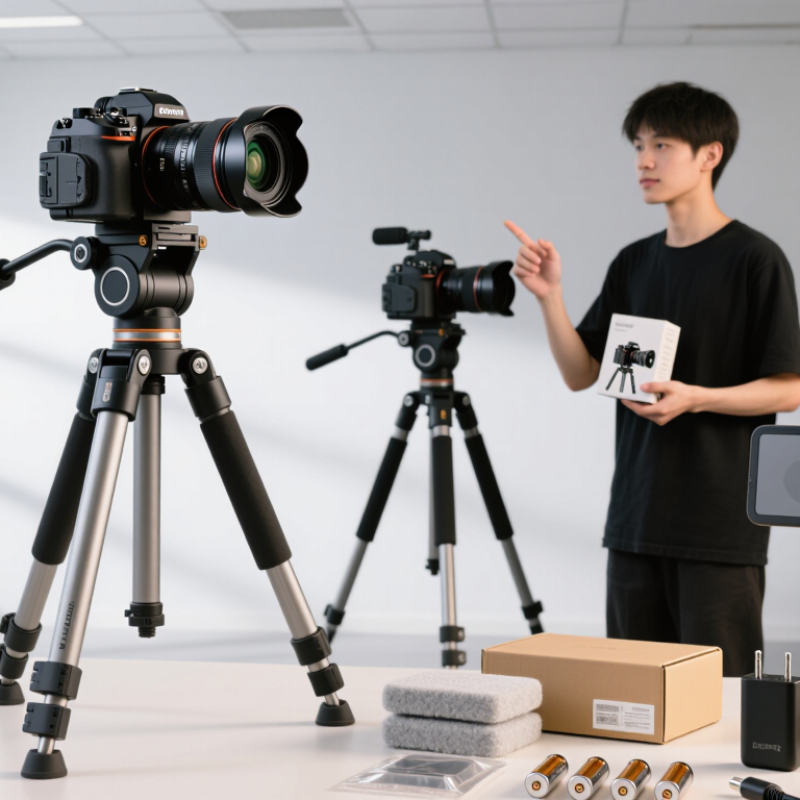
AI smart tripods combine motorized movement, camera support, and software-based subject tracking. A useful model should follow a walking person smoothly, not merely detect a face. Check tracking speed, rotation range, noise level, and recovery after the subject leaves the frame. Image stability matters more than impressive artificial intelligence claims. Test sample footage in bright rooms, dim corners, and outdoor locations.
For solo creators, the tripod can support tutorials, product demonstrations, travel videos, and remote lessons. Teachers may use automatic framing during practical classes. Small teams can record interviews without hiring a camera operator. Event users need quiet motors and dependable tracking near moving crowds. A clear control application should offer manual override, framing zones, firmware updates, and accessible privacy settings.
Sourcing requires more than comparing online specifications. Request production samples and record the same movement several times. Measure battery performance, charging time, payload capacity, and heat after extended use. Verify materials, warranty terms, repair options, and applicable safety documentation. Supplier audits should include quality records and realistic delivery schedules. Some tracking systems perform poorly with hats, masks, or quick turns. That limitation deserves honest testing. A lower-cost unit may look attractive, but unstable software can create expensive reshoots. Specification sheets also miss small frustrations, such as delayed controls or difficult tripod locks. Evaluate the daily experience, not only the feature list.
Before sourcing AI smart tripods in 2026, define the working budget, not just the purchase price. Wyzowl’s State of Video Marketing 2025 report found that 89% of businesses use video as a marketing tool. This suggests steady demand for reliable mobile production equipment.
A basic sourcing budget should include the tripod, lighting, microphone support, shipping, spare batteries, and replacement parts. A practical pilot budget may range from 80 to 250 dollars per unit. Higher prices do not always mean better tracking.
Write a technical checklist before contacting suppliers. Confirm the maximum payload, folded height, working height, motor noise, battery runtime, charging port, and device compatibility. For AI tracking, request measured detection distance and response latency. “Tracks people” is too vague. Ask for tests at three distances, under weak indoor lighting, and during side-to-side movement.
Deloitte’s 2024 State of Generative AI report found that many organizations expect AI to reshape operations within three years. However, automation still needs measurable performance standards.
Consider data handling carefully. Check whether face or voice data leaves the device, how long records remain stored, and whether users can disable tracking. Request sample test videos and a failure-rate report.
I would also order a small batch first. My early estimates can be wrong. A tripod that performs well in a showroom may shake beside a moving subject. Field testing often reveals the uncomfortable details.
Sourcing AI smart tripods in 2026 requires more than comparing catalog prices. A reliable supplier should explain factory capacity, component sources, inspection routines, and warranty handling. Request recent production photos, sample serial records, and a video call from the assembly floor. Ask whether the same motor, battery cell, and tracking sensor appear in mass production. A polished sample can hide inconsistent batches. I learned this the hard way after a tripod arrived with smooth movement but noisy gears.
Evaluate product quality with repeatable tests. Extend and fold the tripod 500 times, then check leg locks, hinge pressure, and phone stability. Test tracking in dim rooms, side lighting, crowded backgrounds, and slow movement. AI claims should be measurable: face reacquisition time, tracking distance, gesture accuracy, app permissions, and offline behavior. Ask for test data under identical conditions, not edited demonstrations. Some suppliers may exaggerate capabilities. Buyers can also misjudge early samples when testing conditions are too gentle.
Tips: Keep three samples from separate production batches. Compare motor noise, charging time, heat, and tracking accuracy. Request firmware change logs and a clear update policy. Confirm privacy controls, regional safety compliance, and written quality tolerances. Cheap units may pass a showroom test but fail after daily use. Supplier transparency matters as much as technical performance.
Sourcing AI smart tripods in 2026 requires evidence, not attractive product pages. Deloitte’s 2024 State of Generative AI report found that many companies remain concerned about reliability and governance. That concern applies to tracking devices. Ask suppliers for CE, FCC, UKCA, RoHS, and REACH documents for your target markets. Battery-powered models may also require UN38.3 testing. Verify certificate numbers with the issuing laboratory. A scanned logo proves little.
Order samples before discussing large volumes. Test face tracking under backlight, weak Wi-Fi, crowded backgrounds, and slow movement. Measure payload capacity with your intended phone or camera. Check motor noise, app stability, firmware updates, and privacy settings. I once approved a smooth sample that overheated after forty minutes. It was an avoidable mistake. Request at least three units from different production batches when possible. Keep written test records, including temperature and failure time.
Pricing should include the tripod, remote control, packaging, software access, spare parts, freight, duties, and inspection costs. The International Data Corporation’s 2025 AI spending outlook shows continued growth in AI-related hardware investment, but rising demand does not guarantee fair pricing. Request tiered quotations for 100, 500, and 1,000 units. Confirm whether the minimum order quantity applies per color, model, or firmware version. A low MOQ may hide higher unit costs. Payment milestones should follow sample approval and pre-shipment inspection. Supplier promises still need measurable acceptance criteria.
| Product Configuration | Typical AI Functions | Camera and Tracking Specifications | Mechanical and Power Requirements | Certifications and Documents to Verify | Sample Requirement | Indicative Sample Price | Indicative Bulk Price | Typical MOQ | Estimated Production Lead Time | Key Acceptance Tests |
|---|---|---|---|---|---|---|---|---|---|---|
| Entry-Level Smartphone Model |
Person detection Face tracking Automatic horizontal rotation Mobile application control |
Smartphone clamp width: approximately 55–90 mm Tracking distance: approximately 3–8 m Horizontal rotation: approximately 360° Vertical adjustment: commonly 20–30° |
USB rechargeable battery Typical operating time: approximately 4–8 hours Lightweight plastic or aluminum construction Standard tripod mounting thread recommended |
Verify before order Applicable electrical safety test report EMC test report Battery transport documentation if a lithium battery is included RoHS and REACH material declarations where required |
Order 2–3 samples: 1 for functional testing 1 for endurance testing 1 for packaging and quality inspection |
Approximately US$35–80 per sample | Approximately US$18–45 per unit, depending on battery, app, packaging, and order volume | Approximately 100–500 units | Approximately 20–35 days after approval of specifications |
Tracking accuracy under normal indoor lighting Rotation noise Battery runtime Clamp strength Bluetooth or Wi-Fi connection stability |
| Mid-Range Smartphone and Compact Camera Model |
Human and face tracking Gesture or application control Subject re-centering Preset shooting positions Basic auto-framing support |
Smartphone and compact-camera compatibility Tracking distance: approximately 5–12 m Horizontal rotation: typically 360° Vertical movement: commonly 30–45° Recommended payload: approximately 0.5–1.5 kg |
Metal-reinforced pan-and-tilt mechanism Rechargeable battery or external USB-C power Replaceable mounting adapter preferred Non-slip base and standard mounting thread |
Document review required EMC and electrical safety reports for the target market RoHS and REACH declarations UN 38.3 and MSDS documentation for lithium batteries App privacy policy and software permission disclosures |
Test at least 3 samples from the same production configuration: 1 for software testing 1 for mechanical testing 1 for destructive or long-duration testing |
Approximately US$70–150 per sample | Approximately US$40–95 per unit, depending on motors, sensors, software, and accessories | Approximately 100–300 units | Approximately 25–45 days after sample approval |
Target reacquisition after subject leaves frame Pan-and-tilt repeatability Motor temperature App compatibility with current operating systems Drop, vibration, and connector tests |
| AI Auto-Framing Creator Model |
Multi-person detection Face and upper-body tracking Auto-framing for live streaming Subject-priority selection Remote control and preset positions |
Integrated camera or supported external camera Wide-angle field of view commonly 70–120° Tracking distance: approximately 5–15 m Resolution commonly 1080p or higher when a camera is integrated Payload: approximately 1–2 kg |
Two-axis or three-axis motorized movement Continuous or high-capacity battery option USB-C power input recommended Heat dissipation and firmware update capability required |
Verify by destination market EMC, radio, and electrical safety compliance for wireless models RoHS and REACH documentation Battery safety and transport records Software bill of materials or cybersecurity questionnaire for enterprise buyers |
Request 3–5 samples with identical firmware and hardware revision. Require a written sample approval report before mass production. |
Approximately US$120–250 per sample | Approximately US$75–180 per unit, depending on camera module, AI processing, memory, and connectivity | Approximately 100–500 units | Approximately 30–60 days after final engineering approval |
Auto-framing latency Performance with multiple subjects Low-light tracking Audio-video synchronization if microphones are integrated Firmware update recovery Continuous operation for at least 4–8 hours |
| Professional Camera Support Model |
Subject tracking through a control application or compatible camera system Programmable motion presets Remote pan-and-tilt control Optional object or face tracking through an external device |
Payload commonly 2–5 kg Compatibility with interchangeable-lens cameras must be confirmed Standard mounting thread or quick-release plate Typical pan range: 360° continuous or wide-angle movement Typical tilt range: approximately 90–120° |
High-torque motors Reinforced metal frame External power option recommended Counterbalance or locking mechanism may be required for heavy cameras |
Confirm certificate scope EMC and electrical safety reports Radio certification where wireless functions are included RoHS and REACH declarations Battery transport documents if applicable Mechanical load-test report and material specification |
Request 2 engineering samples and 1 production-equivalent sample. Test with the exact camera, lens, battery, and mounting accessories planned for sale. |
Approximately US$250–600 per sample | Approximately US$160–450 per unit, depending on payload, motors, control system, and included accessories | Approximately 50–200 units | Approximately 35–70 days after engineering validation |
Maximum-load stability Emergency stop response Motor noise and vibration Tilt-lock performance Long-duration operation Compatibility with the specified camera setup |
| Customized OEM or Private-Label Model |
Customized tracking algorithm or interface Private-label mobile application Custom enclosure, packaging, and accessories API or software integration Region-specific language and cloud settings |
Specifications negotiated by project Camera resolution, field of view, tracking range, and payload must be fixed in the product specification Firmware version and supported operating systems must be recorded |
Custom tooling may be required Custom battery, connector, motor, or mounting system may affect certification Define service life, operating temperature, ingress protection, and charging requirements |
Certification plan required Obtain certification reports for the final hardware revision, not only a similar model Confirm radio, EMC, electrical safety, chemical, battery, privacy, and cybersecurity requirements for each destination market Require a declaration of conformity where applicable |
Approve an engineering validation sample, design validation sample, and production sample where the project is substantially customized. Keep a signed golden sample for incoming inspection. |
Approximately US$500–2,000 per project sample set | Approximately US$120–600 per unit, excluding tooling, software development, certification, and special packaging | Approximately 300–2,000 units | Approximately 60–120 days, excluding certification and tooling delays |
Golden-sample comparison Firmware and application version control Certification traceability Packaging and labeling accuracy Batch consistency Data privacy and cloud-service review |
When sourcing AI smart tripods in 2026, the contract should describe more than unit price. Define tracking accuracy, battery capacity, charging standards, app compatibility, and operating temperature. Use measurable acceptance tests, not vague promises. Require a pilot batch before full production. This can expose unstable Bluetooth connections and noisy motors early. One trial I reviewed revealed a problem. The sample worked indoors but lost tracking beside a busy road. Small detail. Important lesson.
Set delivery terms with clear inspection points. State who pays for tooling, customs clearance, insurance, and damage claims. A realistic schedule should include component shortages and port delays. Keep serial-number records for every shipment. They support warranty decisions later. Do not accept a rushed contract. Pressure may hide missing specifications.
After-sales support needs its own service-level agreement. Set response times, replacement rules, firmware support, and spare-parts availability. Request repair videos and multilingual troubleshooting guides. Remote diagnosis can reduce returns, but it cannot fix cracked housings or damaged batteries. Require safe handling procedures and compliant disposal instructions. Confirm data protection responsibilities if the tripod connects to accounts or cloud services.
Test the support channel before signing. Send a difficult question. Measure the answer. A polite reply is not enough. Review packaging strength and final inspection reports. Reserve a small payment until documents and performance checks are complete. This may slow negotiations. It can prevent expensive surprises. Still, no agreement is perfect. Local service capacity may remain uncertain. Plan quarterly reviews and adjust the process when field evidence challenges your assumptions.
It combines motorized movement, camera support, and software-based subject tracking. It should follow people smoothly, not only detect faces.
Check tracking speed, rotation range, recovery after leaving the frame, and performance during quick turns. Hats and masks may cause failures.
They support tutorials, product demonstrations, travel videos, remote lessons, interviews, and practical classes. Small teams can record without a camera operator.
Stable footage is more useful than impressive artificial intelligence claims. Test recordings in bright rooms, dim corners, and outdoor spaces.
It should offer manual override, framing zones, firmware updates, and clear privacy settings. Delayed controls can become frustrating.
Record the same movement several times. Measure battery life, charging time, payload capacity, heat, motor noise, and connection stability.
Include tracking accuracy, battery capacity, charging standards, app compatibility, operating temperature, and measurable acceptance tests. Avoid vague promises.
A pilot batch can reveal unstable connections, noisy motors, or weak tracking before full production. One sample may work indoors but fail near traffic.
Define inspection points, tooling costs, customs clearance, insurance, damage claims, and delivery schedules. Include possible component shortages and port delays.
Set response times, replacement rules, firmware support, spare-parts availability, repair guidance, and safe battery disposal procedures. Service capacity may still remain uncertain.
Sourcing AI Smart Tripods in 2026 requires a structured process that connects product capabilities with real user needs. Begin by defining key features and use cases, such as automated subject tracking, voice or gesture control, remote operation, camera compatibility, stability, battery life, and portability. Then establish a realistic budget and technical requirements, including required materials, payload capacity, software compatibility, privacy protections, and expected production volume.
Next, compare suppliers by evaluating manufacturing experience, product quality, intelligent functions, customization options, and communication efficiency. Before making a decision, verify relevant certifications, request samples, test tracking accuracy and mechanical performance, and confirm pricing, lead times, payment terms, and minimum order quantities. Finally, create a clear contract covering specifications, inspection standards, delivery responsibilities, warranty terms, spare parts, and after-sales support. Careful planning at every stage can reduce sourcing risks and help buyers secure reliable products that meet both market expectations and operational requirements.